This is super cheeky for a work blog — and I thought long and hard about whether to use it — but it’s really, truly one of the questions I’m asked most frequently by friends and family who know me personally, not professionally. And it’s usually followed by some version of:
“And why on earth do you care so much about them?” or
“Why should I care about them?”
I’ve always focused most of my content and work on expert and in-training OKR practitioners, since there is so much need in that territory. And often, I have business leaders who are new to OKRs stumble into my No-BS OKRs bundle and end it telling me:
“You have GOT to get this material in front of people who have never heard of OKRs.”
So here we go.
See how OKRs work in context
Since OKRs don’t exist in a vacuum, I’ve put together the Connected Strategic Stack Example — a free download that shows you where OKRs fit in the bigger picture:
-
A real, working example of a complete strategy picture — from big vision all the way to the daily work that gets you there;
-
A glossary for every piece of the stack, in plain English (no MBA required);
-
And a one-page framework you can use to see what your organization has — and what might be missing — in its own strategy picture.
You can snag it now or come back to it after you’ve read through this post.
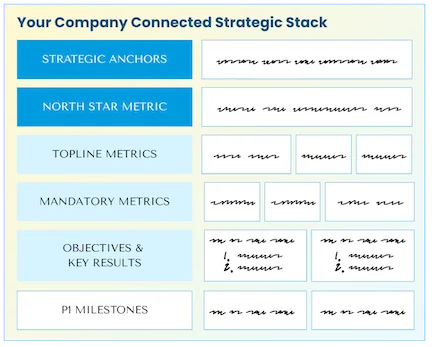
The Connected Strategic Stack Example is a free download that shows you where OKRs fit in the strategy picture — from vision to daily work, all on one page.
WTF are OKRs?
OKR stands for “Objectives and Key Results.”
OKRs are a framework organizations use to close the gap between strategy and execution — translating big-picture direction into measurable progress that teams can actually work toward. In practice, they give everyone a shared language for what success looks like, replacing “I think we’re on track” with numbers that tell you whether you are.
The “O” stands for Objectives — directional, qualitative statements of what’s most important and why it matters. The “KR” stands for Key Results — the specific, measurable targets that tell you whether you’re achieving that objective.
The Basics: Objectives and Key Results
What is an objective?
An objective is an ambitious, directional (not measurable) statement of shared purpose. Think of it like a mini-vision statement — something that gives you and your team direction and focus for the current goal cycle.
A well-written, complete objective answers two questions: What’s most important? And why does it matter?
Notice what’s missing from those questions: numbers (that’s where key results come in); and how you’ll do it. That’s intentional. When an objective describes how you plan to achieve something rather than what’s important and why, it’s likely to go stale the moment circumstances change — whereas an objective built around direction and purpose stays relevant even when your approach shifts.
Example objective:
Balance our environmental footprint through unheard-of advances in every element of our technology.
That objective names the direction — balancing our environmental footprint — and the ambition behind it: unheard-of advances across every element of our technology. Not a word about how, because the how can change over time. The measures come next.
What is a key result?
A key result is an aspirational, objectively measurable target that shows you whether you’re making measurable progress toward — or achieving — your success criteria and objectives.
Key results answer: What will success look like in measurable terms? Or: How will we know we’re making progress — or that we’re at risk, before it’s too late?
The key word is measurable — not “percentage complete” (which usually reflects a subjective estimate, not objective data), and not “we completed X” (a binary result). Measurable means that a number representing empirical impact goes up or down, and that number tells you something meaningful.
One useful test: a strong key result usually starts with a directional verb — increase, decrease, reduce, improve. If it starts with an action verb — create, launch, revamp, implement — you’re describing what you’ll do, not what you’ll achieve.
Example key result tied to the objective above:
Decrease the amount of electronic waste generated by technology operations by 30% (from 100 metric tons to 70 metric tons).
Directional verb: ✓. Clear metric: ✓. Specific change: ✓.
One more thing about key results: they’re experiments, not guarantees or mandatories. A true key result has an element of “we influence this, but we don’t fully control it.” If it’s fully within your control, it’s probably a plan, not a key result.
A simple OKR example
Here’s how an objective and key results work together, at a team level:
Theme: Talent and culture
Objective: Build the kind of workplace where people stay because they want to — and bring their best thinking when they do.
Key results:
- Increase employee engagement score from 58% to 75% by year-end
- Decrease voluntary attrition from 22% to 12% annually
- Increase the percentage of open roles filled internally from 10% to 30%
For a team that might otherwise just execute on a list of HR initiatives, these key results create something different: a measurable picture of what “better” looks like, and a way to ask whether the work you’re doing is actually moving things in the right direction. The initiatives and programs are how you get there — they’d live in a separate section of the planning tool. The key results are what you’re aiming to achieve.
How OKRs relate to other goal tools
If you’re wondering how OKRs relate to KPIs, SMART goals, or other frameworks you may already use, that comparison deserves its own treatment — check out OKRs vs. KPIs vs. SMART Goals for the full picture.
Doesn’t everybody already know how to write goals?
We all have experience with goals — but every person has a different relationship with goals and goal-setting, and a different set of beliefs, practices, and heuristics around goals and goal-setting, so without effort, two people rarely naturally speak the same “goal language.”
- Some people approach everything in their life with a vision or goal, then work back from it to inform their choices;
- Some people prefer to make plans, and then work forward from their plans to achieve what they can;
- And some people have been harmed by unfair, biased, or incoherent applications of goals (especially in the workplace).
So every person brings a different set of experiences (and baggage) to goal-setting, and even in organizations that have some sort of documentation or guidance about their goal model, it’s pretty rare for that guidance to coherently define and align the practices and behaviors that connect strategy through to implementation in a way that’s actually clear and useful.
So yes, most people know how to write goals, but speaking different goal languages leaves room for expectation clarity fails, misunderstandings, and misalignments. And even if you’re working on personal or individual goals, you may have goal habits that don’t actually support your goal achievement (and joy).
Why might an organization need an aligned goal framework?
Are any of these situations familiar?
- Have you ever found it unclear what’s expected of you at work?
- Have you and a colleague, leader, or client disagreed about whether a particular piece of work was successful — or whether the goal for a piece of work was achieved by enough to be considered a win?
- Have subjective estimates of progress led to missing the mark on a critical lagging outcome?
- Have you seen, or experienced, arbitrariness around who gets credit for good work, or other forms of bias in recognition of success?
- Have you been in an organization with an employee feedback survey question like: “I know how my work matters” or “I know how my work aligns to strategy,” and those scores are low?
If you’re a leader … the conditions I just listed (and their friends) are signs that your organization may benefit from a more organized approach to aligning strategy and implementation — which a coherent OKR implementation is really good at.
And if you’re an employee … you may be in a tough spot, with leaders who struggle to set and communicate a strategy, or stick to one — where the goal posts are always moving. Or, you might be spending more of your energy than you think trying to mind-read what’s expected of you. If that’s you, even if your organization doesn’t use OKRs, I’ve got some tips about how YOU might, to help create clearer expectations for yourself (and improve your career satisfaction while you’re at it).
What’s different about No-BS OKRs?
In a lot of organizations, OKRs are about the numbers and charts and graphs on a dashboard, and often they’re implemented because senior leadership wants more visibility into the organization’s progress, as well as improved results.
No-BS OKRs — the flavor of OKRs I created and work with — achieve those basics, and also:
- Increase the organization’s change-readiness by surfacing important truths to be tackled head on.
- Focus on aligning what we do — our behavior — to what we ultimately must achieve — so we find ourselves spending less time “doing all the things” whether or not they’re contributing to our most important outcomes; and more time focused on what’s important to move forward to maximize progress toward your strategy or vision.
- Are aligned with the best available science on motivation and peak performance, and are informed by my own extensive experience as an executive, an employee, a conflict resolution pro, a trauma-informed coach, and a status-quo challenger and changemaker.
Historically, a lot of my material has been geared toward experienced OKR practitioners and leaders who are implementing OKRs (or, turning around implementations that have gone off the rails). But when I say the acronym OKR, it turns off a lot of people that No-BS OKRs could actually really help.
If you’re new to OKRs and this is landing — the free Connected Strategic Stack Example is a perfect next step. It’ll show you where OKRs fit in the bigger picture of strategy, so you can start to see not just what OKRs are, but how they connect to everything else your organization is trying to achieve.
No-BS OKRs are one of the sharpest tools in my toolkit. I help leaders and the people they count on most move strategy out of decks, docs, and the conference room into the everyday actions and decisions of every person in the organization.
So if any of that sparks your interest, grab the free Connected Strategic Stack Example and see how No-BS OKRs fit into the full picture.
OKR FAQs for Beginners
How many OKRs should a team have?
The fewest possible — that's the core principle. The point of OKRs isn't to document everything your team is working on; it's to name the small number of things that actually need to improve, and create a measurable picture of what improvement looks like.
For key results specifically: you need at least two per objective — one that measures progress along the way (a leading indicator), and one that measures the outcome you're ultimately aiming to achieve. You might have up to four or five, but every one you add spreads your team's focus a little further. Keep the volume focused and the page readable.
At the team level, even fewer. If you can fit everything on one page and still read it in a single sitting, you're in good shape.
How often do you set OKRs?
It depends on the level of the organization. At the company level, OKRs typically align to the annual planning rhythm — set once a year, reviewed and recalibrated quarterly. Functions and sub-teams usually run on quarterly cycles, which gives them enough time to make real progress while staying responsive to what's changing.
What matters more than the specific cadence is creating a consistent rhythm: set goals, work toward them, review and learn from the results, and iterate. Whether that's quarterly or annual, the discipline of that rhythm is what makes OKRs work.
Do we have to implement OKR software to use OKRs?
No. Most teams I work with start with a simple one-page format — a document or spreadsheet that fits their full set of OKRs on a single page. Software can be helpful once you're running a mature, multi-team OKR system, but it's not a prerequisite. Starting simple helps you focus on the methodology adoption so people really learn how to work with and use OKRs, rather than being distracted by learning a new piece of software.
Can I use OKRs for personal goals?
Yes. Even if your organization doesn't use OKRs, the framework is genuinely useful for individual career and performance goals. It gives you a way to articulate not just what you want to accomplish, but what achieving it might actually look like in measurable terms.
What's the difference between a key result and a milestone?
One of the most important questions organizations learn during their first cycle working with me: Is mere completion success? If yes — if getting it done is the win, and there's no meaningful improvement to measure — it's a plan or a milestone. If no — if you need to achieve some kind of measurable outcome, not just finish the work — it's a key result.
Most operational work (run payroll, launch the product, complete the audit) belongs in plans and milestones. Key results belong to the things that need to get better.
How do I know if my key result is actually measurable?
Start with the right question: not "what can I measure?" but "what's most important to achieve — and how will I know empirically that I'm making progress?" A key result is measurable when someone else can verify it without asking you to interpret. "Improve customer satisfaction" isn't a key result yet. "Increase customer satisfaction from 72% to 85%" is — because the data either shows it or it doesn't.
If you're struggling to find a measurable number, that's normal and worth working through. Sometimes you need to instrument a new metric, use a proxy measure, or start with an estimate and refine it. The point is to get to something empirical: facts, not feelings.
What's the most common beginner mistake you see with OKRs?
Including activity in key results. If people are allowed to include activity, they have zero reason to actually take the risk of identifying possible outcomes or progress measures — and people are almost always going to default to activity, because it feels more within our control than the uncertainty of writing actual key results.
So early on, a lot of key results read like: "Launch the new onboarding flow" or "Complete six customer interviews." Those are plans (or quantified activity) — perhaps valuable ones! — but they belong in your project plans, not your OKRs. A key result describes what progress or success look like in measurable terms, not what you'll do to get there. (The questions to ask: "When we do that thing, what will change? What number goes up or down? What would it mean to succeed wildly when that's done?")
Have more questions?
Send them my way — I'd love to hear them. I'm building an uber-FAQ with all the common questions and answers I get from students and clients — and I'd love to add yours to it!