What Needs an OKR (and What Doesn't)
Not everything your team does needs an OKR. One sorting question cuts through the land grab.

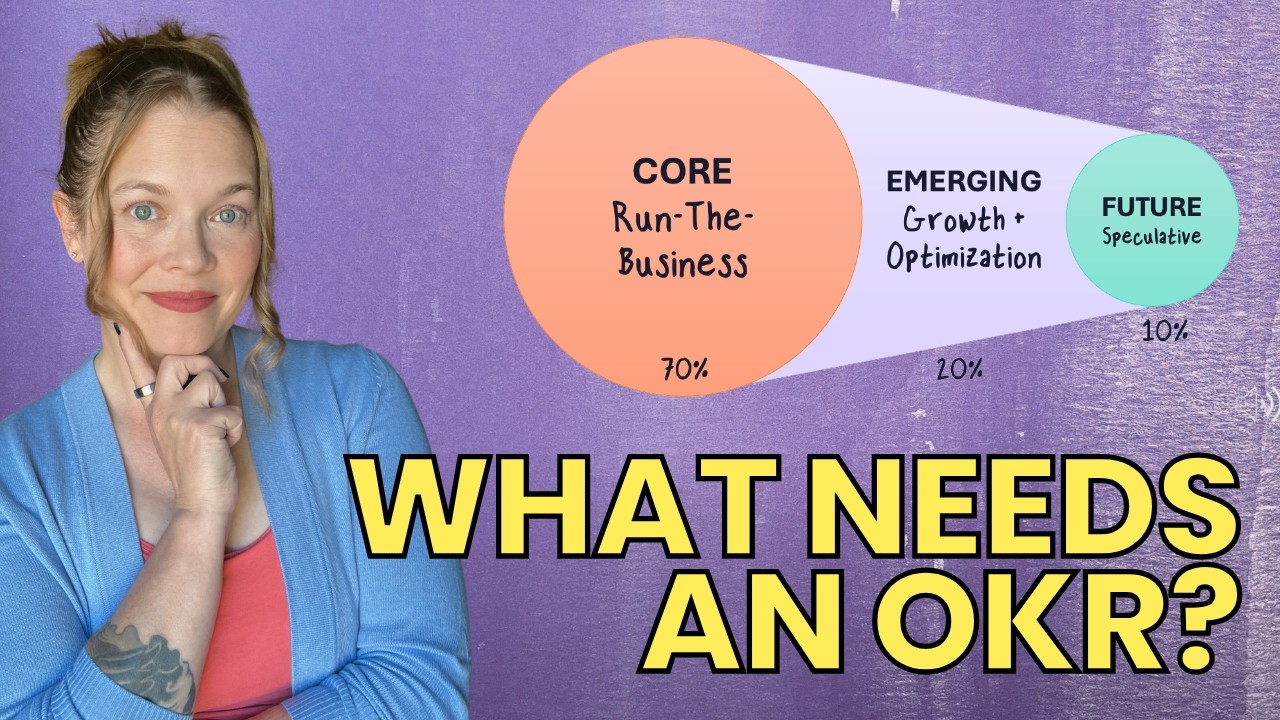
Sara Lobkovich’s No-BS OKRs framework uses one question to sort what belongs in your OKRs from what doesn’t: Is completion success? Work where getting it done is the win belongs in a delivery plan, not the OKRs. Work where completion alone isn’t success needs a measurable key result.
Does everything your team does need to be in the OKRs?
There's a sorting question that cuts through this: Is completion success?
If your team treats OKR planning like a land grab — everyone fighting to get their project visible because if it’s not in the OKRs, it doesn’t feel important — you’re not alone. That pressure is real, and it’s understandable. People want their work to matter, and they want their contributions to be visible. But when everything gets crammed into the OKRs, the OKRs stop doing the one thing they’re supposed to do: focus attention on what needs to improve, not just what needs to get done.
There’s a sorting question that cuts through this: Is completion success?
Is completion success?
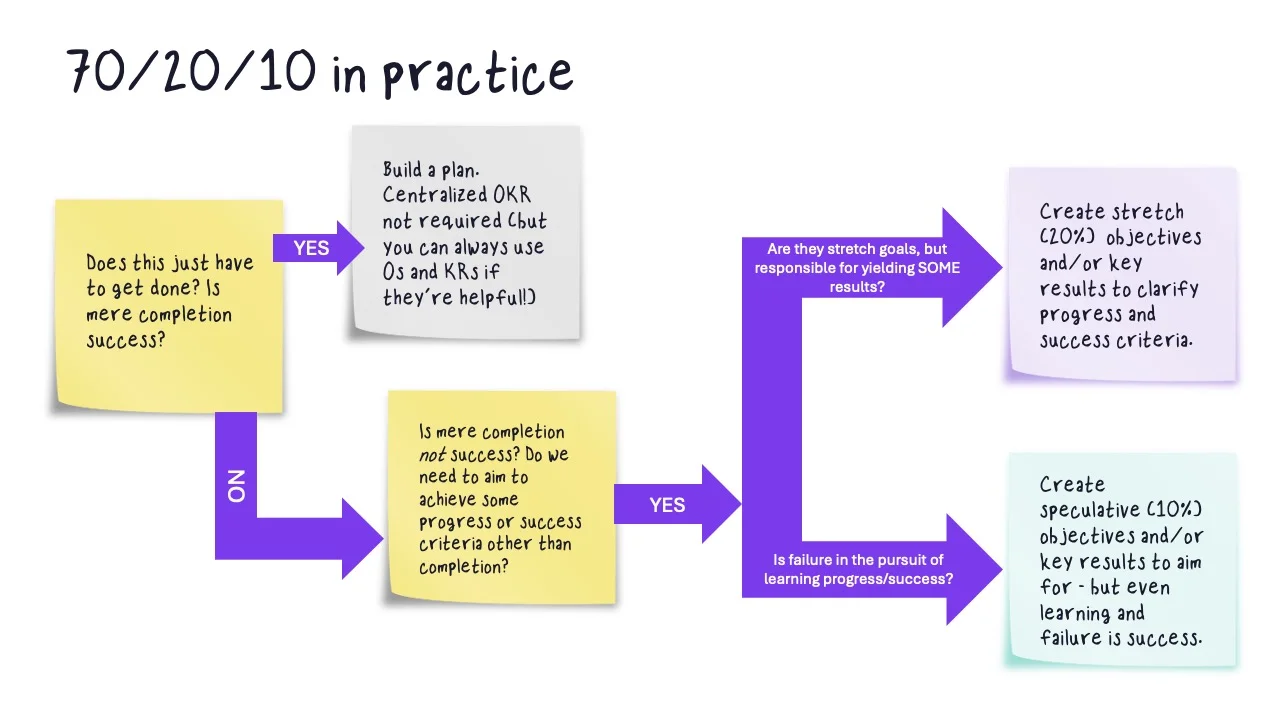
- Yes → It’s a milestone, a mandatory, a delivery commitment. Track it as delivery: what gets done when.
- No → It needs a key result. Mere completion isn’t success, so you need measurable criteria for what progress or improvement actually looks like.
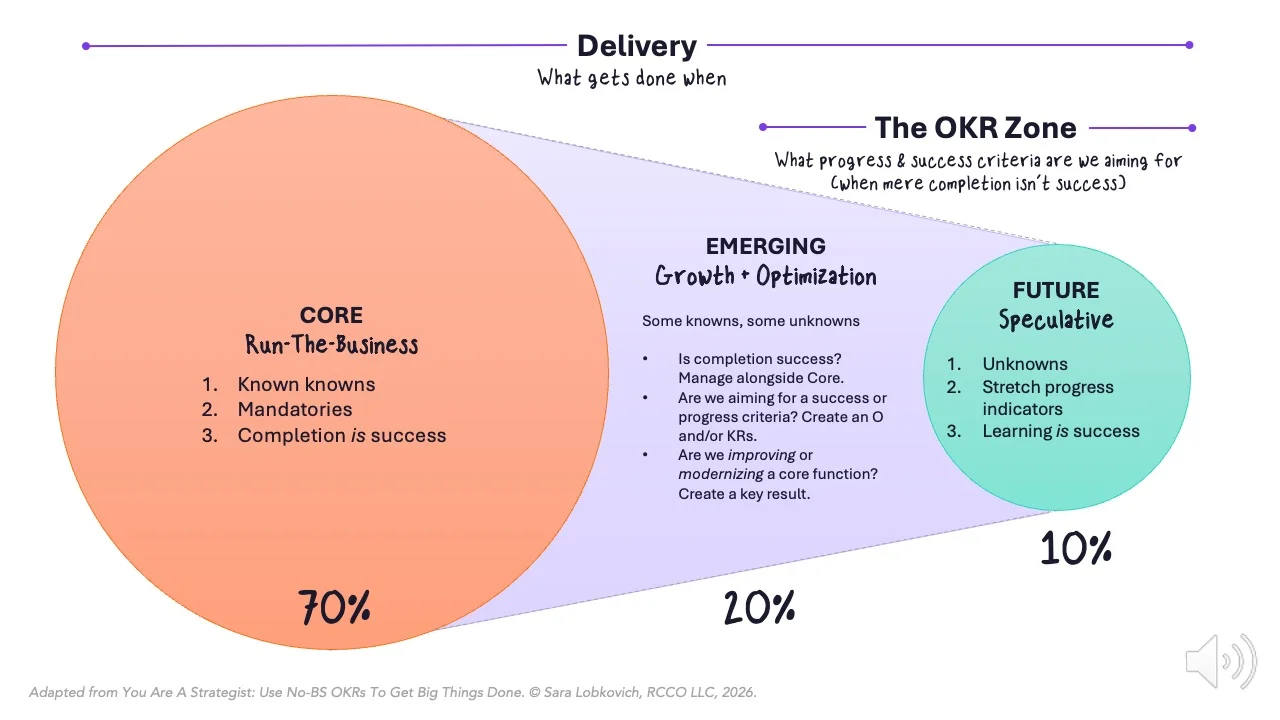
That one question creates two zones. Delivery — the work where getting it done is the success. And the OKR zone — where completion alone isn’t success, and where you need measurable outcomes to know whether you’re actually making progress or succeeding; or whether you’re off track and need to change tactics.
Here’s what the decision flow looks like in practice:
Delivery vs. the OKR zone
Every business has a run-the-business responsibility. That’s where your “known knowns” live. Mandatories, milestones, must-achieve deadlines. The work where completion is success. Different organizations call this different things: delivery, run-the-business, business as usual, core. Whatever the label, this work doesn’t need OKRs if it just has to get done. It needs clarity about what gets done when, and commitments people can count on each other to keep.
Then there’s the work at the other end of the spectrum: future-focused, speculative stretch goals — the work where even just learning is success. So many unknowns, and even unknown unknowns, that it’s not really possible to set goals with any degree of realistic certainty. In your OKRs, you’re setting the destination on the map: what you think you want to aim for in terms of what success might mean.
Objectives give you directional clarity in both zones. The difference is that in the OKR zone, you’re pairing those objectives with measurable key results. In delivery, you’re pairing them with deadlines, milestones, and commitments that are mandatory — so that people can count on each other’s commitments about what gets done when.
The 70/20/10 mapping
The 70/20/10 model comes out of the Center for Creative Leadership (CCL), where it started as a learning and development framework: 70% of professional development happens experientially — on the job; 20% socially — working alongside others; and 10% formally — book smarts. But that shape, dividing effort across a spectrum from proven to speculative, has been applied to all sorts of other situations since. I first ran into it in my agency life, where we used it to plan marketing effort and spend: 70% sure-thing, proven tactics; 20% growth-focused, slightly riskier experiments; and 10% totally out there — purely speculative bets.
The same shape maps to how organizations can think about their work.
The 70% — what needs to be “done right.” Your run-the-business work. The known knowns. Mandatories, milestones, deadlines. Completion is success.
The 10% — what needs to be “done curiously.” Your most speculative initiatives. Growth-focused, experimental, stretch. You’re setting wildly speculative goals and key results where you’re looking for progress, improvement, some kind of success. There’s still a stretch, still unknowns — but you’re setting a destination on the map.
The 20% — what needs to be done as right and curiously as possible. This is the work that sits in between: it isn’t success just because it’s done. Mere completion isn’t success. You may still have stretch goals reflected in key results, but you’re in the territory where you can hold the work accountable to performance metrics. You know more than the 10% zone — you can realistically set a key result that isn’t just an experiment.
Your OKRs live in the 20% and 10%. Your delivery lives across the board, but delivery clarity in the form of plans is especially important in the 70%.
But that's a lot of stuff. How do we keep track of all of it?
A lot of people have “if I can’t see it, it doesn’t exist” brains. (I am definitely one of them, and I envy people who don’t.) The minute something moves to a second piece of paper — or gets buried in a digital system — our brains let go of it. Digital systems tend to be black boxes: we don’t remember what’s in them, and there’s no accounting for the fact that human working memory isn’t infinite… so we can lose track of what’s in our systems that are designed to help us remember things.
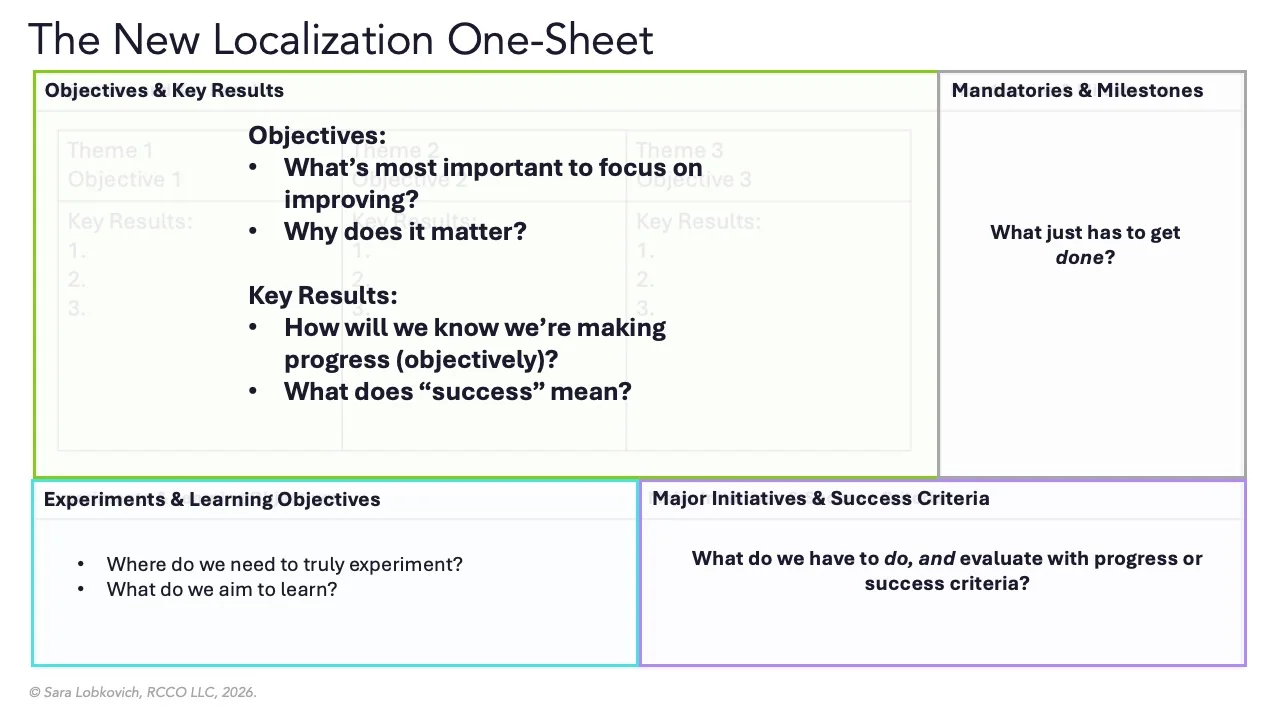
That’s why I’m such a huge stan for one-sheets. Fitting information — expectations — down to a single 8.5 x 11” piece of paper forces prioritization, focus, and decisionmaking. And then, it keeps shared expectations — what the team is pursuing, what they’re committed to, what they’re experimenting toward — visible on a single page.
Making payroll on time is as important as any stretch goal. The most important things are not always in the OKRs — that's a common misconception.
This template I use with clients works because it reflects how organizations actually function: some teams will have a bigger OKR box and a smaller delivery box, and some will have the opposite. It depends on the nature of the work. But the same structure applies to any team, any initiative, even individual contributors — because every effort likely has some work in each zone: improvement or change that warrants measurable outcomes, mandatory commitments stakeholders are counting on, and meaningful experimentation toward learning objectives.
Making payroll on time is as important as any stretch goal. The most important things are not always in the OKRs — that’s a common misconception. The one-sheet makes both zones visible at once.
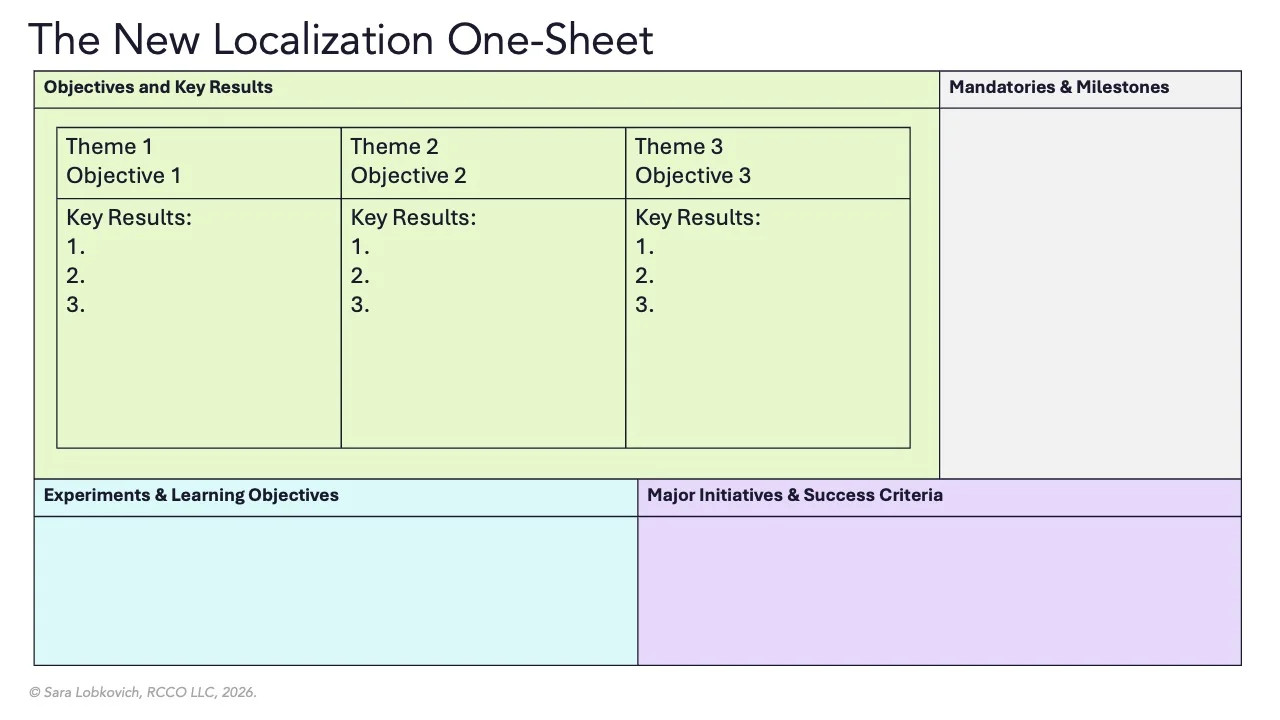
Each section asks a different question:
The benefits of clearly separating activity and outcomes
When you establish shared norms around whether a piece of work calls for completion-based planning or stretch-goal setting, people gain clarity about whether they need to be correct — executing a mandatory, hitting a deadline, honoring a commitment — or curious — exploring, experimenting, pursuing improvement with verifiable targets.
That distinction matters for psychological safety. When people feel like their work only matters if it’s in the OKRs, the OKR planning process becomes a land grab. This model breaks that dynamic. It lets you say clearly: some of the most important work in this organization surfaces through delivery processes, not OKRs. OKRs stay focused on growth and change — and delivery gets the clarity it deserves in the form of plans and committed milestones.
When people feel like their work only matters if it's in the OKRs, the OKR planning process becomes a land grab.
When leader behavior aligns with that — when delivery work is genuinely honored, and OKRs stay limited to what actually needs measurable outcomes — people stop competing for OKR visibility. They know where their work belongs, and why.
Over subsequent cycles (not the first one — don’t try this on day one), you can start asking: what are we doing in the run-the-business zone that should be more efficient? How do we free up capacity? And what about the work that doesn’t align at all — should we do less of it, or stop?
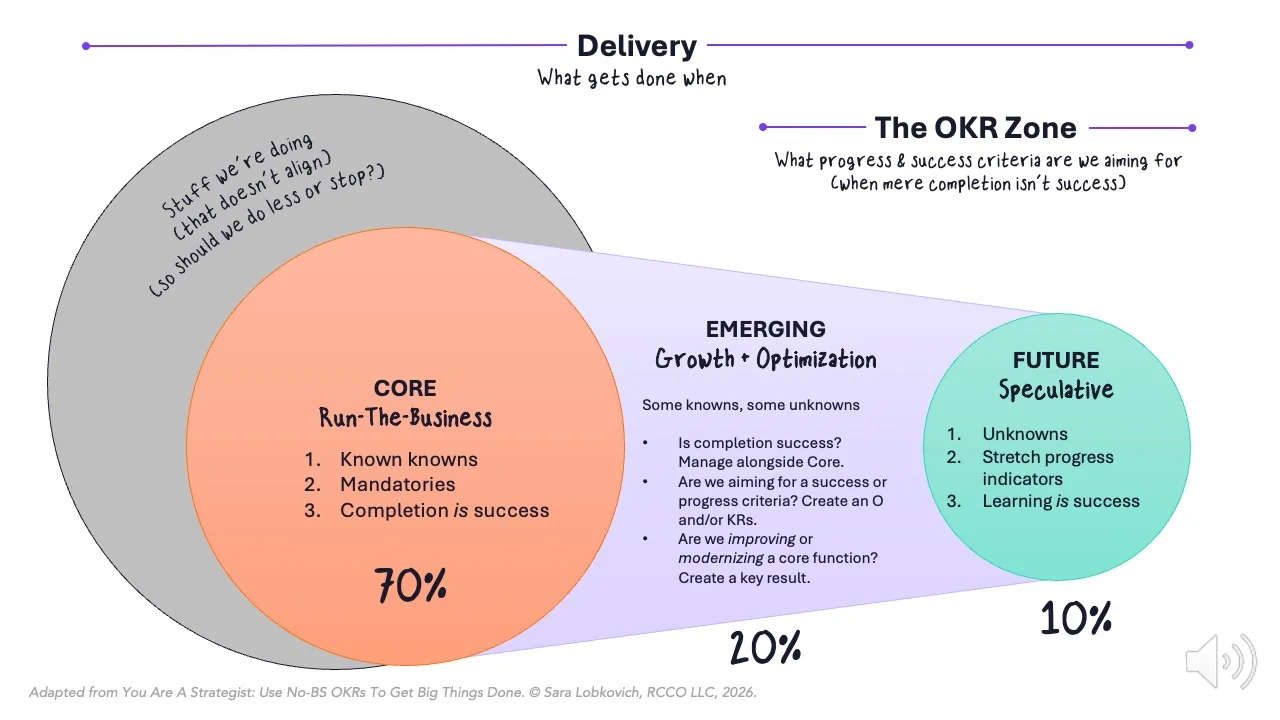
When you move delivery — with its subjective estimates of completion — into the run-the-business space, and keep your 20% and 10% focused on truly measurable outcomes, you’re working from facts, not feelings. Verifiable truths. That gives you more information to make unbiased prioritization decisions.
Want the full-size slides? Click any image above to download the PDF.
Keep learning: Watch the full No-BS OKRs Fundamentals playlist, or explore the No-BS OKRs methodology.
Go deeper with the book
The No-BS OKRs framework explained in full — with templates, examples, and the complete methodology.
Get the BookReady to implement OKRs with your team?
Book a free Q&A call to talk through your OKR setup.
Sara Lobkovich
Sara is the creator of the No-BS OKRs methodology. She's spent 16+ years in executive and leadership roles across startups and Fortune 500 companies, and is an OKR Master Coach. She wrote the book — literally.
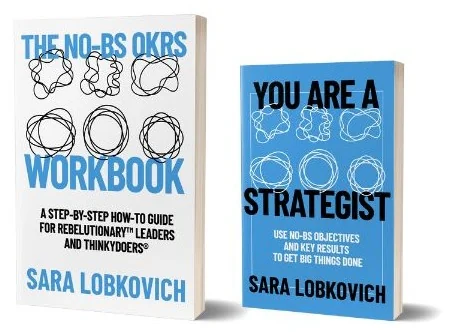
You Are a Strategist: Use No-BS OKRs to Get Big Things Done
The practical guide to setting direction, making real progress, and clarifying priorities you and your collaborators can trust.
Get the BookReady to Implement OKRs?
Self-schedule a 25-minute Q&A to see if we're the right match. You'll walk away with answers to your questions and actionable insights, whether we work together or not.
Book a Q&A Call