Eight common OKR mistakes I see — across Fortune 100s and early-stage startups.
Most aren’t about how goals are written. They’re about leadership behavior, organizational expectations, and what gets left undefined.
Most OKR implementations don’t struggle because people can’t write objectives. They struggle because the organizational conditions for OKRs — the leadership modeling, the shared vocabulary, the explicit distinction between aspirational and mandatory — were never established in the first place.
Here are the eight mistakes I see most often, and what to do about them.
The Mistake of Accountability Misunderstanding
One of the biggest mistakes organizations make with OKRs is leaders operating with the belief that accountability in the form of OKRs is for everyone else within the team. This misconception often stems from leaders adopting OKRs for the rest of the organization without recognizing that they, too, must be accountable.
Successful OKR implementation requires leaders to model the behaviors they expect from their teams. When the leadership takes ownership of their objectives and models excellent key result creation (and continuous learning), it cascades down through the organization and fosters a culture of accountability at all levels. Ensure your leaders are aligned and ready to showcase the desired behaviors before rolling out OKRs across the board.
Overlooking Terminology and Definitions
Another common pitfall is treating the definitions of objectives and key results as mere semantics. Many organizations operating under the OKR model frequently grapple with understanding the distinction between these crucial terms. This lack of clarity can lead to misalignment and ineffective goal setting.
To combat this OKR mistake, it’s essential to establish a clear glossary of terms and definitions early in the process. This ensures that everyone involved is on the same page and understands what an objective and key result signify within the context of your organization.
Not Distinguishing Between Stretch and Mandatory Goals
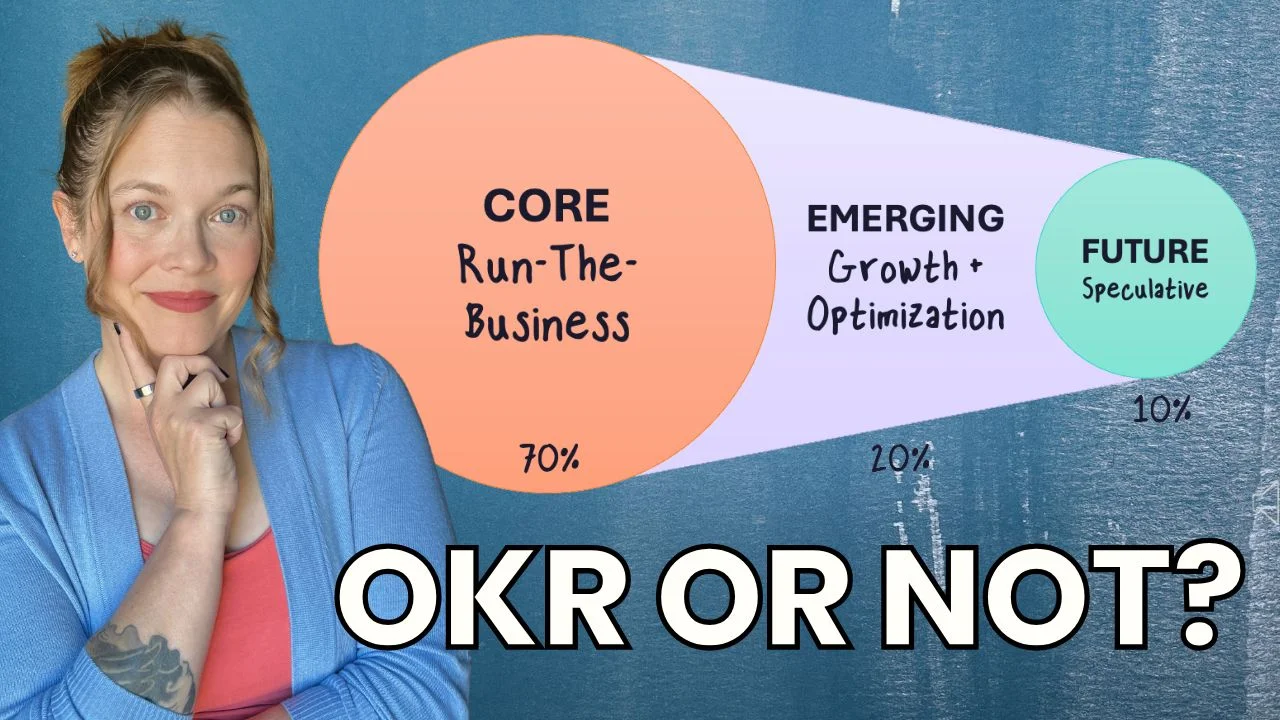
Stretch goals are aspirational — they push teams into uncertain territory, challenge conventional thinking, maximize time in flow state, and extend the period of active goal pursuit. Mandatory goals, by contrast, are non-negotiable commitments: financials, major delivery milestones, critical dependencies.
When the line between these two types isn’t clearly drawn, it becomes a trust issue. People get penalized for not fully achieving stretch goals when no minimum threshold was ever communicated — essentially treating a stretch goal as mandatory after the fact.
Sara: Personally, I reserve mandatory goals for the areas of financials, milestones for major delivery moments and big dependencies. But almost everywhere else, if you’re in a growth-focused culture, you’re likely to gain more from stretch goal-setting than from setting conservative mandatory goals.
This confusion falls especially hard on your best people. Ambitious, high performers are naturally wired for stretch goal-setting. When stretch and mandatory goals are muddled, those high performers can face negative consequences for not fully achieving their ambitious targets — even if they far outperformed what a mandatory target would have required. Meanwhile, conservative performers who hit 100% of safely-set goals may be maximized for reward. The result: performance left on the table, and incentives that actively work against high performance.
The recognition and reward dimension of this — both collective and individual — deserves more care than most organizations give it. When goal-setting operates in isolation from how people are recognized and rewarded, you create a system where the rules aren’t actually the rules. Getting this right is one of the most impactful things a leadership team can do, and OKRs done well provide the framework to do it.
Too Much, Too Many Objectives and Key Results
When it comes to OKRs, more is not better. A frequent error is inundating teams with an influx of objectives and key results. Too many targets can overwhelm teams and dilute focus, ultimately leading to subpar results and completely missing the mark on why most organizations adopt OKRs in the first place.
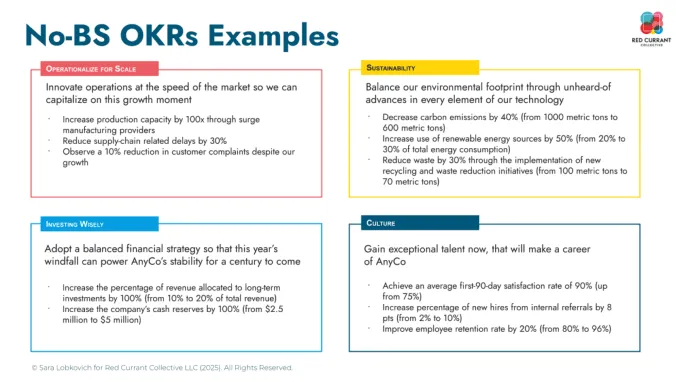
Finding a balance is essential. Aim for fewer objectives with significant impact rather than stretching yourself thin across numerous goals. And only include true key results — actual empirically measurable goals that describe your essential progress and outcome measures. Key results are about what you aim to achieve (if everything goes right) — not a checklist of milestones.
This approach will allow your teams to dedicate the necessary energy and resources to achieve the objectives and key results that truly matter.
Simple Solutions to Simplify OKRs
-
Limit Objectives: Choose a maximum of three or four key objectives.
-
Narrow Down Key Results: For each objective, strive for two to four key results, maximum.
By focusing your approach, you help to ensure that everyone remains aligned and focused on what truly drives success.
Setting Goals Around Activities Instead of Outcomes
Organizations tend to set goals in three default categories: major financial metrics, activities (what needs to get done), and occasionally major outcomes. Very few are skilled at identifying progress measures, process goals, or leading indicator goals — the data that tells you whether you’re on or off track with certainty greater than a subjective estimate.
When the only numerical goals a business communicates are financial, that gives sales, marketing, and the executive team some clarity about what’s expected. But most line staff can’t look at financial goals and understand why or how their daily work connects to those numbers. The result is a large part of the organization working without meaningful goal clarity.
People resist creating outcome-based goals because activity feels controllable in a way that outcomes don’t.
Sara: We feel like we control our activity. We don’t feel like we control our outcomes because we don’t. We influence them. We have to make that leap — that it’s more important sometimes to sign up for goals we may influence, even if we don’t control them, because that’s how we really achieve change and high performance in uncertain territory.
Objectively quantifiable, metric-based goals should exist across the organization — its themes, its projects — not only for financial measures. That’s where real clarity and alignment happen.
Cascading OKRs to Multiple Layers
Cascading OKRs through too many levels of the organization is another misconception that can lead to confusion and ineffective execution. Attempting to waterfall objectives down through too many layers often results in a lack of clarity and can dilute the intended outcomes.
Instead of cascading OKRs through multiple layers, focus on a more manageable structure. Limit the cascade to two levels in most cases, which provides for excellent cross-functional goals at the top or company level, and clear “localized” functional goals at the second level. In all but the largest (e.g. global / multi-region organizations, or organizations that are made up of separate “company-like” entities) companies, this gives enough detail for the rest of the organization to “align up” to the top-level OKRs. That way, the system of OKRs remains small, but their alignment power is huge. Aligning up to well-written top-level OKRs ensures that everyone understands how their contributions directly affect the overall goals.
Over-Focusing on Existing KPIs Instead of Building New Measurability
When organizations do reach beyond financial metrics to set metric-based goals, they often stop at their existing dashboards — customer satisfaction, retention, margin, and other established Key Performance Indicators. These are important. But starting and finishing your goal-setting with existing KPIs means creating goals about a world that already exists.
If you’re operating in a high-change, high-innovation, or transformational space, you need goals about a world that doesn’t yet exist. That requires building new measurability — getting creative about how to objectively quantify progress and impact without established business metrics.
Practices for this include creating index measures from available data, writing Key Results based on desired or undesired observable behavior, and baselining to fill data gaps so you can set goals around what matters most — not just what you can already measure.
Ask yourselves:
-
What data are we overlooking, and how can we improve our measurability for the future?
-
What metric, the absence of which, is hurting our ability to improve?
Tying OKRs to Performance Management
One significant mistake that organizations often make is linking OKRs too closely with performance reviews or pay. (This issue is so serious, and such a common desire among prospects, that I have an entire blog post and other resources written to deep dive into why OKRs and performance management should not be linked unless you’re very careful to ensure there are no unintended consequences.)
Instead, treat OKRs as a forward-thinking framework that encourages growth and learning, together as a group. They should inspire teams to stretch beyond their comfort zones without the looming pressure of performance-based repercussions.
Key Takeaway: Avoiding OKR Mistakes for Better Implementation Success
To successfully implement OKRs in your organization, it’s critical to avoid the mistakes that can derail your process. Here are the primary insights you should take away:
-
Emphasize Leadership Accountability: Model the behaviors you want to see.
-
Clarify Terminology: Establish a shared understanding of key terms.
-
Distinguish Stretch from Mandatory: Be explicit about which goals are aspirational and which are non-negotiable — and make sure your recognition and reward systems reflect that distinction. Your high performers depend on it.
-
Simplify Objectives and Key Results: Focus on fewer, more impactful goals.
-
Shift from Activities to Outcomes: Sign up for goals you influence, not just tasks you control.
-
Limit Cascading Depth: Restrict the cascade to only a few organizational levels.
-
Build New Measurability: Don’t let existing dashboards define the limits of your ambition — create goals about the world you’re building, not the one you already have.
-
Decouple from Performance Management: Use OKRs to encourage innovation and growth, rather than as a tool for performance reviews.
OKRs done well — especially the No-BS OKRs framework I work with — address each of these pitfalls directly. When implemented well, OKRs are a series of quick, efficient, simple questions and answers that serve as a shared language for increasing focus, clarity, and alignment — and ultimately your performance impact.
Want more No-BS OKR fundamentals like this?
Subscribe to my No-BS OKRs Fundamentals YouTube Playlist here, or check out my new No-BS OKRs Fundamentals Private Podcast!