Methodology
Strategy isn't a document. It's a practice.
People come to us when something needs to change. When "we need to be more strategic about this." When there just has to be a better way.
Most strategic plans fail because they're designed for the boardroom, not the hallway. They sound clear at the offsite but fall apart in daily decisions. The problem isn't the strategy — it's the gap between the plan and the behavior that's supposed to follow.
I built these frameworks because I needed them myself. As an executive, I watched goals that sounded clear in the boardroom fall apart in the hallways. When I started focusing on the behavioral implementation that most programs ignore — everything clicked.
Now I help leaders, chiefs of staff, and other force multipliers close that same gap. Not with more philosophy or another software tool, but with practical systems that change how people actually work.
Three frameworks. One connected approach.
Each piece does a specific job. Together, they close the gap between what you planned and what actually happens.
The Connected Strategic Stack
Distill the most important information teams need to execute — down to a single piece of paper.
Every organization has a strategic implementation stack. Most have gaps: between the vision and the annual plan, between quarterly goals and daily work, between what leaders intend and what teams actually do.
The Connected Strategic Stack maps every layer — from mission and vision through strategic priorities, OKRs, and key initiatives down to individual goals — so you can see exactly where the disconnects are and close them.
No-BS OKRs
A shared language for high-performance goal setting, from the CEO to the summer intern.
Most OKR implementations get stuck on syntax: the "right" way to write an Objective, the scoring rubric, the alignment cascade. That stuff isn't useless, but it isn't where the work is.
No-BS OKRs focus on what matters: getting clear on what you're trying to achieve, measuring whether it's actually changing, and building the organizational muscle to stay focused when everything wants your attention. Outcomes over activities. Clarity over complexity.
Behavioral Implementation
Connecting the dots on how each person's work matters — so strategy actually changes behavior.
Strategy fails when it's designed for the boardroom but ignored in the hallways. The real work isn't writing the plan — it's changing how people make decisions, set priorities, and follow through.
I focus on building strategy into the operating rhythm of the organization: clear expectations, low-friction habits, and feedback loops that improve employee engagement and impact by helping people at every level see how their work connects to the bigger picture. If a strategic tool isn't helping someone make a better decision today, it isn't working.
How the pieces fit together
The Connected Strategic Stack gives you the map — a clear picture of how every layer of your organization's strategy connects to daily work.
No-BS OKRs give you the engine — a practical way to set meaningful goals, measure what matters, and stay focused on outcomes instead of activities.
Behavioral implementation gives you the practice — the habits, rhythms, and feedback loops that make strategy part of how your organization actually works, not something that lives in a deck.
The result: strategy that changes behavior. Not more planning theater. Not another framework that gathers dust. A connected system where every person in the organization can see how their work connects to the bigger picture — and where leaders have the signal data to know whether the plan is working.
The gaps this methodology closes
Most organizations experience predictable disconnects in their strategic implementation stack. You'll probably recognize a few of these.
The hope / confidence gap
Leaders project optimism but lack objective signal data to know whether the organization is actually performing to plan.
The activity / impact gap
Teams complete their task lists and check every box — then wonder why the needle hasn't moved. Activity isn't the same as progress.
The urgency / importance gap
Strategic planners focus 3-5 years out while implementation teams survive their next sprint. Nobody has a shared calendar for what matters now.
The fuel / friction gap
Leaders keep adding fuel — more persuasion, more enthusiasm — when unseen organizational frictions are what's actually blocking progress.
Built for Thinkydoers
Thinkydoers are motivated as much by questions as answers, wired for deep work, and not satisfied with thought experiments. Their insights drive impact. This methodology is built for them.
The CEO or Executive
You own the strategy. You've invested in alignment. But you keep watching execution stall — and you're not sure why. You need someone who can diagnose the behavioral gaps, not just deliver another framework.
The Force Multiplier
You're the one who actually makes things work — the Chief of Staff, program manager, or strategic operator who bridges vision and reality. You need tools that make your job easier, not harder.
The Individual Strategist
Strategy is a skill, not a job title. Whether you're an individual contributor, a middle manager, or a team lead, the ability to connect your "why" to your "what" is the key to getting things done without burning out.
Go deeper
Explore the methodology through the book, free resources, and real examples.
You Are a Strategist
The full methodology in book form. No-BS OKRs, the Connected Strategic Stack, and practical tools for closing the strategy-execution gap. BookLife Editor's Pick.
Connected Strategic Stack Example
See how strategy actually connects to daily work. A real example of the Stack in action, with a glossary of every term.
OKR FAQ
Common questions about OKRs, the No-BS approach, and getting started. Plain answers, no jargon.
The Connected Strategic Stack
The original article explaining the framework, including a gap analysis of where most organizations' strategic stacks break down.
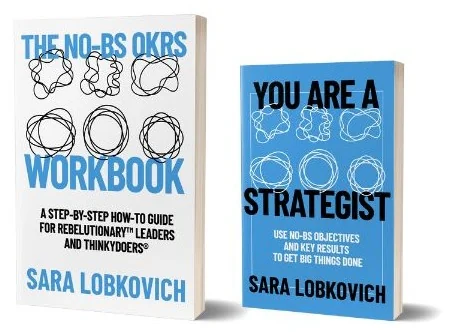
You Are a Strategist: Use No-BS OKRs to Get Big Things Done
The practical guide to setting direction, making real progress, and clarifying priorities you and your collaborators can trust.
Get the BookExplore No-BS OKRs
See how Sara's expertise in OKRs, strategic alignment, leadership, and organizational transformation connects — all in one interactive map.
Explore the Topic MapReady to close the strategy-execution gap?
A 25-minute Q&A to see if this approach fits your situation. Your questions, real answers, zero pressure.
Not ready for a call? Send Me Your Questions — tell me what's going on and I'll send you my honest take.