Questions & Answers
Frequently Asked Questions
Answers to common questions about OKRs, the No-BS approach, and working with Sara.
OKR Basics
What are OKRs?
Objectives and Key Results (OKRs) are a method for collaborative goal setting and alignment. In practice, well-formed OKRs can help fill the gap between high-level strategy and tactical implementation decisions, so that what we do is better aligned with achieving our most important outcomes. OKRs derived from Peter Drucker's concept of Management by Objectives and were popularized by John Doerr's book Measure What Matters. Based on the enthusiasm that book created, thousands of organizations worldwide have adopted OKRs. Some have succeeded; others have struggled — and how you implement matters as much as whether you implement.
What are No-BS OKRs and how are they different from traditional OKRs?
No-BS OKRs strip away the corporate jargon and overcomplicated frameworks that make traditional OKRs feel inaccessible. The No-BS approach focuses on practical implementation: clear objectives that actually mean something to your team, measurable key results that track real progress, and a cadence that works for your organization—not a one-size-fits-all quarterly cycle. Traditional OKRs often get bogged down in scoring systems and alignment cascades. No-BS OKRs keep the focus on what matters: getting clear on what you're trying to achieve and how you'll know when you've achieved it.
What are Evolutionary OKRs®?
Evolutionary OKRs are the 'flavor' of OKRs that emerged from my work mostly with high-change, innovation-oriented, system-transforming organizations where success depends on improving outcomes on human impact measures. If you're in an organization where improving the bottom line depends on improving performance on hard-to-influence outcome measures — like human safety, health outcomes, or educational outcomes — then the Evolutionary OKR model is designed specifically for your organization. Evolutionary OKRs are a thinking, deciding, and learning practice that helps achieve greater growth, transformation, and innovation by aligning on the most important measures of success and progress before deciding on action or activity plans for the goal period. Evolutionary organizations aren't overly attached to pet projects — they have more objective data to make decisions based on, because they're unafraid of quantifying goals, success, and progress in the pursuit of improving outcomes.
Are OKRs quarterly or yearly?
The answer varies by organization. A typical implementation includes annual company-level OKRs (with quarterly targets where needed for important progress data visibility), and then most sub-organizations and teams create OKRs quarterly or trimesterly. This approach gives a balance so there's steady longer-term direction at the company level, while you're able to shift and change at the pace of your market and capitalize on near-term urgency by focusing on progress at the quarterly level as well as the most important annual outcomes.
Are OKRs the same as goals?
Not quite. Goals are broad statements that describe what you want to achieve, like 'increase sales by 20%.' OKRs go a step further by setting specific objectives and measurable key results to track progress. For example, an objective could be 'improve customer satisfaction' with key results such as 'increase NPS score by 10 points' or 'reduce customer support response time by 50%.' Goals provide direction; OKRs provide clarity and measurability to drive success.
How many OKRs should an organization have?
Less than you think. Most organizations try to track too many objectives at once, which dilutes focus and makes everything feel equally (un)important. For most teams, 3-5 objectives per cycle is the sweet spot. Each objective should have 2-4 key results. If you're new to OKRs, start even smaller—maybe just 1-2 objectives—until you build the muscle memory for setting and tracking goals effectively. The goal is focus, not comprehensive coverage of everything you do.
Should OKRs focus on activities or outcomes?
Outcomes, always. This is one of the most common mistakes in OKR implementation. Activities are things you do; outcomes are the results of those activities. Your key results should measure whether you achieved what you set out to achieve, not whether you completed a checklist of tasks. For example, 'Launch new onboarding program' is an activity. 'Reduce new employee time-to-productivity from 90 days to 60 days' is an outcome. The second tells you whether your work actually made a difference.
Should OKRs be tied to performance reviews and compensation?
This is a nuanced question, and the answer depends on your organizational culture. The short version: be careful. When OKRs are directly tied to compensation, people tend to sandbag—setting easily achievable goals to guarantee their bonus. This defeats the purpose of OKRs as a tool for ambitious goal-setting. That said, completely divorcing OKRs from performance conversations can make them feel irrelevant. The No-BS approach: use OKRs as input to performance conversations, not as the sole determinant. Evaluate how people approached their goals, what they learned, and how they contributed—not just whether they hit arbitrary numbers.
What does it mean to be in the red on OKRs and why is that okay?
Being 'in the red' means you're significantly behind on achieving a key result. And here's the counterintuitive truth: if you're never in the red, you're probably not being ambitious enough. OKRs are meant to stretch you. Hitting 100% on every objective suggests you're playing it too safe. A healthy OKR culture expects some red—it's a signal that you're pushing boundaries and learning. What matters is what you do when you see red: Do you course-correct? Do you learn something valuable? Do you communicate transparently about what's working and what isn't?
How do you create OKRs for hard-to-measure areas like creative work or product development?
This is where people often get stuck, but every type of work has measurable outcomes—you just have to get creative about what you measure. For creative work, consider: client satisfaction scores, revision cycles, time from brief to delivery, or portfolio metrics. For product development, look at: user adoption rates, feature usage, bug reports, or customer feedback themes. The key is distinguishing between measuring the work itself (which can feel reductive) and measuring the impact of the work (which is always possible). Ask: 'If this creative/product work is successful, what would be different? What would we observe?' That's your key result.
What about payroll? We have to do it. Does it just get a key result?
Making payroll on time is as important to the organization as any stretch goal—but it doesn't need a key result, because completion is success. Getting payroll out on time is a mandatory. It belongs in plans and milestones, not in the OKR zone. Where operational and support teams do create key results is when something needs to get better. Improving payroll accuracy—if there's a quality or compliance problem—is a key result. Decreasing the number of approval steps required to process an invoice is a key result. The question isn't 'is this important?' It's 'is completion success, or do we need to achieve some kind of improvement?'
I have an important outcome I won't know the result on until December 31st. What do I do in the meantime?
This is the watermelon problem—status reports that are green, green, green all year, until the actual outcome turns out to be red. For outcomes that are genuinely important and genuinely lagging, the question is whether there's anything you can observe before the outcome that would give you signal. Leading indicators come from observation, not from dashboards. They're built by noticing what tends to happen before the outcomes you care about. Think about this as a pipeline problem, not a metrics problem—every important outcome has stages that tend to happen before it. The work of finding leading indicators is figuring out what those stages are for your outcome, in your context. It takes more than one OKR cycle to build something reliable, but once you have it, you have something that gives real signal for years.
Can OKRs and KPIs work together?
Absolutely. In the Connected Strategic® model I work with, the Alignment Layer of our planning stack includes Objectives, Key Results, KPIs, and Commits — and they play distinct roles. Commits are mandatory, 100% must-achieve goals on which we are not safe to fail; the organization must prioritize and resource these. KPIs are the metrics we watch to make sure our business is healthy and headed in the right direction — if the organization had a human body, KPIs would be its blood pressure and pulse. Objectives are our aspirational, directional statements of intent that describe what's most important for the goal term. Key Results are our objectively measurable stretch goals that describe how we're quantifying progress toward our most important outcomes. These aren't competing systems — they work together.
Do OKRs really work?
They can — but that also depends on what you mean by 'work.' OKRs can help organizations increase their sense of shared purpose, clarity, focus, and alignment. Depending on how they're implemented, they can be part of cultural transformation toward greater intellectual humility, continuous learning, experimentation, innovation, and transformation. And OKRs can also fail spectacularly. The methodology isn't magic — implementation matters enormously. The most common failure modes are tying OKRs too tightly to compensation (which drives sandbagging), treating them as a performance review tool instead of a learning tool, and creating so many OKRs that focus evaporates.
Working with Sara
What are Thinkydoers and why does Sara focus on serving them?
Thinkydoers are people who combine strategic thinking with practical execution—they're not just idea people, and they're not just task-completers. They think deeply AND get things done. I focus on Thinkydoers because they're often underserved by traditional consulting and coaching. They don't need someone to tell them what to do (they can figure that out). They need a thinking partner who can help them clarify their strategic direction and then actually implement it. Thinkydoers are also my people—I am one, and I understand the unique challenges of being someone who operates at both the strategic and tactical levels.
What types of organizations does Sara work with?
I work with organizations of all sizes—from startups finding their footing to established enterprises transforming their approach to strategy and goals. What my clients have in common isn't size or industry; it's a commitment to getting better at how they work. They're tired of goal-setting theater and want something that actually moves the needle. I've worked with tech companies, nonprofits, professional services firms, creative agencies, and everything in between. If you're serious about improving how your organization sets and achieves goals, we should talk.
What is the Connected Strategic One-Sheet and why is it important?
The Connected Strategic One-Sheet is a tool I developed to help organizations see their entire strategic picture on a single page. It connects your mission, vision, strategic priorities, and OKRs in a visual format that makes the relationships between them clear. Why is it important? Because most organizations have strategy documents that live in a drawer (or a forgotten Google Drive folder). The One-Sheet is designed to be a living document—something you can reference in meetings, share with new team members, and actually use to make decisions. It's strategy that fits on one page because if it doesn't fit on one page, it's too complicated to execute.
What is the Rebelutionary mindset and why is it important for OKRs?
The Rebelutionary mindset is about challenging the status quo—not for the sake of being contrarian, but because you see a better way. It's the mindset of someone who asks 'why do we do it this way?' and isn't satisfied with 'because we've always done it this way.' For OKRs, this mindset is essential because effective goal-setting requires honesty about what's working and what isn't. You have to be willing to name the elephants in the room, push back on goals that are really just busywork dressed up in OKR language, and advocate for objectives that might make people uncomfortable because they demand real change.
Getting Started
How do I get started with implementing OKRs if I'm new to the concept?
Start small and simple. Don't try to roll out OKRs across your entire organization at once. Pick one team or one project and experiment. Read a book or two (I recommend my book 'You Are A Strategist' for the No-BS approach, or 'Measure What Matters' for the classic introduction). Set your first objective around something you genuinely care about—not something that sounds impressive. Give yourself permission to be bad at it for the first cycle or two. And consider working with a coach (hi!) who can help you avoid common pitfalls and build the habits that make OKRs actually work.
Can individuals use OKRs even if their organization doesn't implement them?
Absolutely. In fact, I'd argue that personal OKRs are a great way to build your goal-setting muscles before trying to influence organizational change. You can use OKRs for career development, side projects, personal growth—anything where you want to get clear on what you're working toward and how you'll measure progress. The practice of setting and tracking personal OKRs will also make you more effective at advocating for better goal-setting practices in your organization. You'll be able to speak from experience, not just theory.
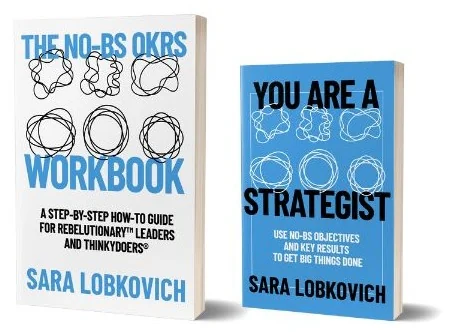
You Are a Strategist: Use No-BS OKRs to Get Big Things Done
The practical guide to setting direction, making real progress, and clarifying priorities you and your collaborators can trust.
Get the BookStill Have Questions?
I'm happy to chat about your specific situation. Let's see if we're a good fit.
Book a Q&A Call