Here’s what good OKRs look like — at every level of an organization.
Objectives and Key Results (OKRs) are a goal-setting framework designed to boost clarity, focus, and alignment in organizations (and for people).
Understanding OKRs for Better Organizational Focus
If you’ve heard about OKRs but wondered what they really mean or how they work, you’re not alone. Objectives and Key Results (OKRs) are a goal-setting framework designed to boost clarity, focus, and alignment in organizations. When implemented coherently, OKRs help teams prioritize what truly matters and measure progress toward ambitious goals. This post will introduce you to a straightforward, practical approach to OKRs that fits well in dynamic environments aiming for real change and innovation: I call this approach: No-BS OKRs. I’ve also included a bunch of best practice No-BS OKR examples, so you can see them in practice, not just theory.
What Are OKRs and Why OKRs Matter
OKRs consist of two parts: objectives and key results.
-
The objective is a clear, ambitious statement expressing what you want to achieve and why it matters. It gives direction but typically isn’t measurable on its own.
-
The key results are specific, measurable outcomes that indicate progress toward the objective. These don’t describe activities but the actual outcomes or improvements you want to see.
Together, objectives provide the purpose and focus, while key results clarify progress and success measures and help keep efforts focused on progress and results instead of in “do the thing, check the box” mode. This combination encourages teams to direct their energy on what’s truly important during their goal cycle, over the course of a quarter, trimester, or year.
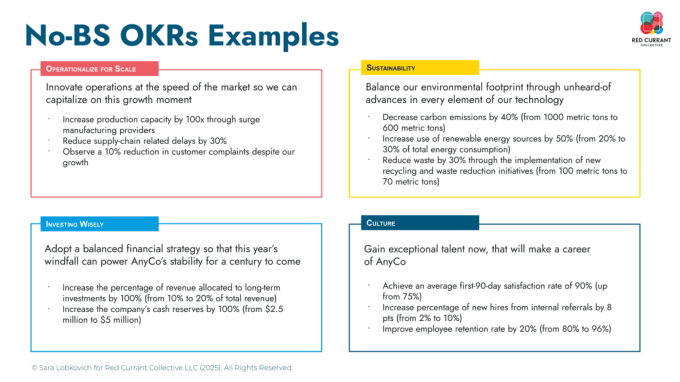
A complete set of company-level No-BS OKR examples, showing how a focused, prioritized set of OKRs can fit on a single page.
How OKRs Work Across Organizational Levels
One of the things that trips people up when first learning OKRs is that the same framework looks different depending on where in the organization you’re applying it. In No-BS OKRs, we think about goals in layers:
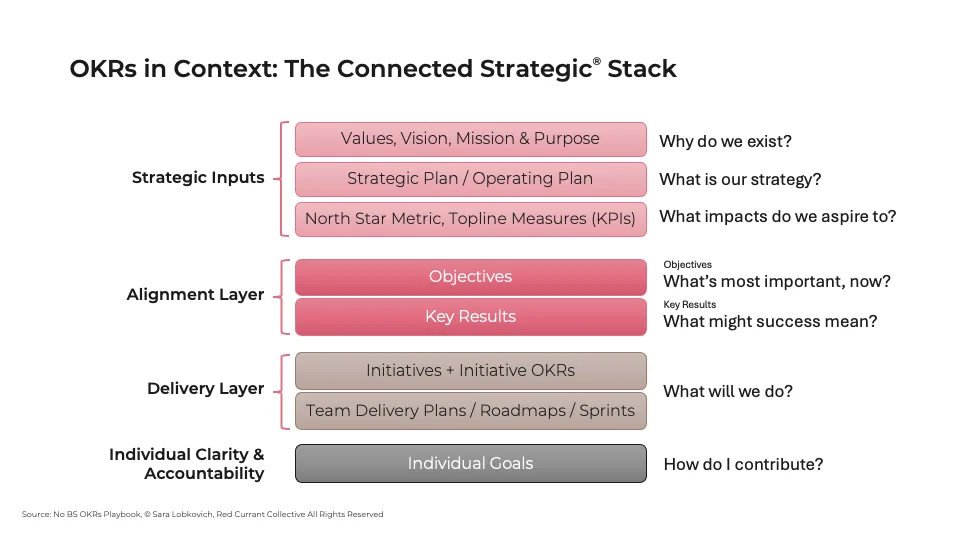
Level 1 (L1): Company OKRs Top-level objectives and key results for the whole organization — the “what’s most important right now and why” for this goal cycle. L1 OKRs set direction and define the themes the rest of the organization aligns to. They fit on a single page.
Level 2 (L2): Functional or Team OKRs OKRs set by departments or functions that align to the company’s L1 OKRs. They’re tighter and more focused, because each team localizes only the objectives they can meaningfully influence. A technology team doesn’t need to localize a sales objective — they localize what’s within their remit.
Initiative OKRs When a specific project is important enough to need its own success measures — and where mere completion isn’t success — it gets an initiative OKR: one objective describing what’s most important, and key results defining what progress and success look like. Initiative OKRs are often cross-functional.
Individual Goals At the individual level, No-BS OKRs takes a bottom-up approach: individuals align their own goals to whatever level of the company OKRs is most relevant to their work. The guiding question at every level: does my work align to a key result, an objective, or a company theme?
The examples below show what each level looks like in practice, using a single fictional company — AnyCo — from top to bottom. Download the full AnyCo OKR examples as a PDF.
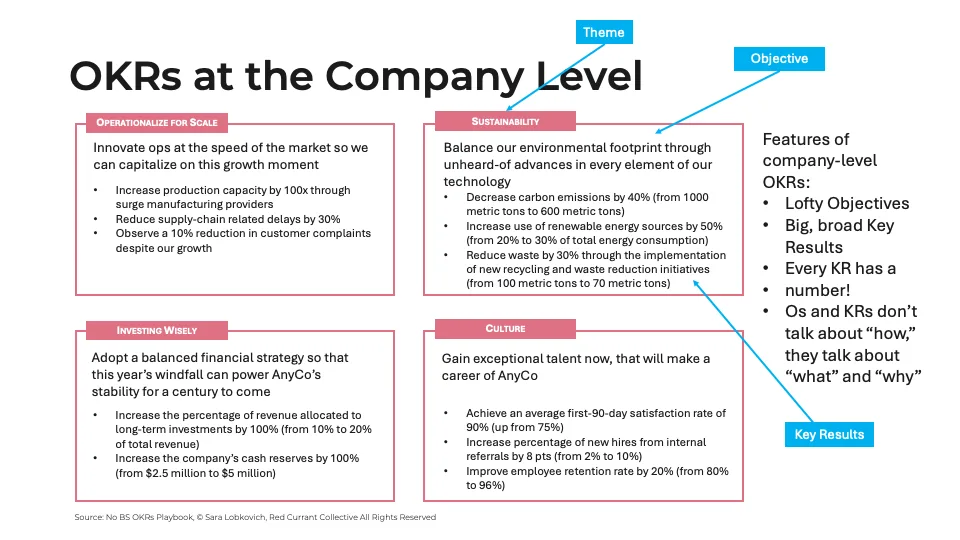
OKRs at the Company Level: AnyCo
Company-level OKRs are organized by theme: broad, lofty objectives that explain what’s most important and why it matters, paired with measurable key results. At the company level, key results tend to be big and broad — many people across the organization contribute to them — but they always have a number.
Here are AnyCo’s company-level OKRs:
Theme: Operationalize for Scale
Innovate ops at the speed of the market so we can capitalize on this growth moment.
Key Results:
- Increase production capacity by 100x through surge manufacturing providers
- Reduce supply-chain related delays by 30%
- Observe a 10% reduction in customer complaints despite our growth
Theme: Sustainability
Balance our environmental footprint through unheard-of advances in every element of our technology.
Key Results:
- Decrease carbon emissions by 40% (from 1,000 metric tons to 600 metric tons)
- Increase use of renewable energy sources by 50% (from 20% to 30% of total energy consumption)
- Reduce waste by 30% through the implementation of new recycling and waste reduction initiatives (from 100 metric tons to 70 metric tons)
Theme: Investing Wisely
Adopt a balanced financial strategy so that this year’s windfall can power AnyCo’s stability for a century to come.
Key Results:
- Increase the percentage of revenue allocated to long-term investments by 100% (from 10% to 20%)
- Increase the company’s cash reserves by 100% (from $2.5 million to $5 million)
Theme: Culture
Gain exceptional talent now, that will make a career of AnyCo.
Key Results:
- Achieve an average first-90-day satisfaction rate of 90% (up from 75%)
- Increase percentage of new hires from internal referrals by 8 points (from 2% to 10%)
- Improve employee retention rate by 20% (from 80% to 96%)
The features to notice: lofty objectives, broad key results, every key result has a number, and none of the objectives or key results describe how anything gets done — they describe what and why. The full set fits on one page.
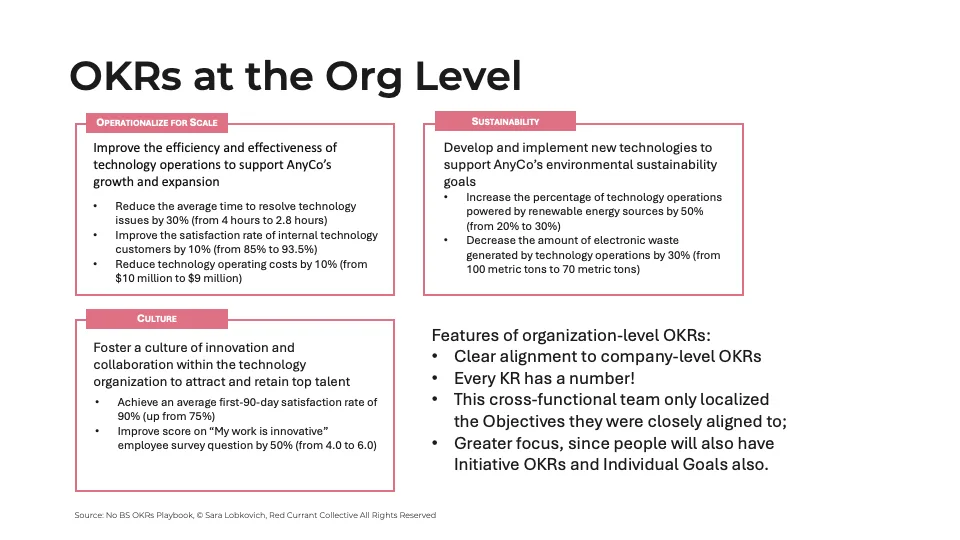
OKRs at the Org Level: AnyCo Technology
When AnyCo’s technology function writes their OKRs, they don’t localize every company objective — only the ones they’re closely aligned to. The technology team doesn’t own the “Investing Wisely” financial objective, so they don’t localize it. They focus on what’s within their remit.
Here are the technology function’s localized OKRs:
Theme: Operationalize for Scale
Improve the efficiency and effectiveness of technology operations to support AnyCo’s growth and expansion.
Key Results:
- Reduce the average time to resolve technology issues by 30% (from 4 hours to 2.8 hours)
- Improve the satisfaction rate of internal technology customers by 10% (from 85% to 93.5%)
- Reduce technology operating costs by 10% (from $10 million to $9 million)
Theme: Sustainability
Develop and implement new technologies to support AnyCo’s environmental sustainability goals.
Key Results:
- Increase the percentage of technology operations powered by renewable energy sources by 50% (from 20% to 30%)
- Decrease the amount of electronic waste generated by technology operations by 30% (from 100 metric tons to 70 metric tons)
Theme: Culture
Foster a culture of innovation and collaboration within the technology organization to attract and retain top talent.
Key Results:
- Achieve an average first-90-day satisfaction rate of 90% (up from 75%)
- Improve score on “My work is innovative” employee survey question by 50% (from 4.0 to 6.0)
Features worth noting: the technology team’s objectives are more specific — localized to their context, not just copied from the company level. Every key result still has a number. And since this team will also have initiative OKRs and individual goals, this set is intentionally tight. Not exhaustive.
A note on localization vs. cascading
The examples above show localization the No-BS OKRs way: each team decides which company objectives they can meaningfully influence, then writes OKRs that connect upward — rather than having objectives and/or key results handed down through the org chart.
It's actually a common misconception that "rolling down" goals is inherently demotivating. According to motivation science, assigned goals can be motivating — when they're provided with an adequate rationale. Rolling goals down without explanation is what creates disengagement. A blend of rationale-supported roll-downs and inspired, bottom-up goals that tap into the team's wisdom creates the strongest OKR alignment.
Initiative OKRs: AnyCo’s AI-Powered Recommendations Initiative
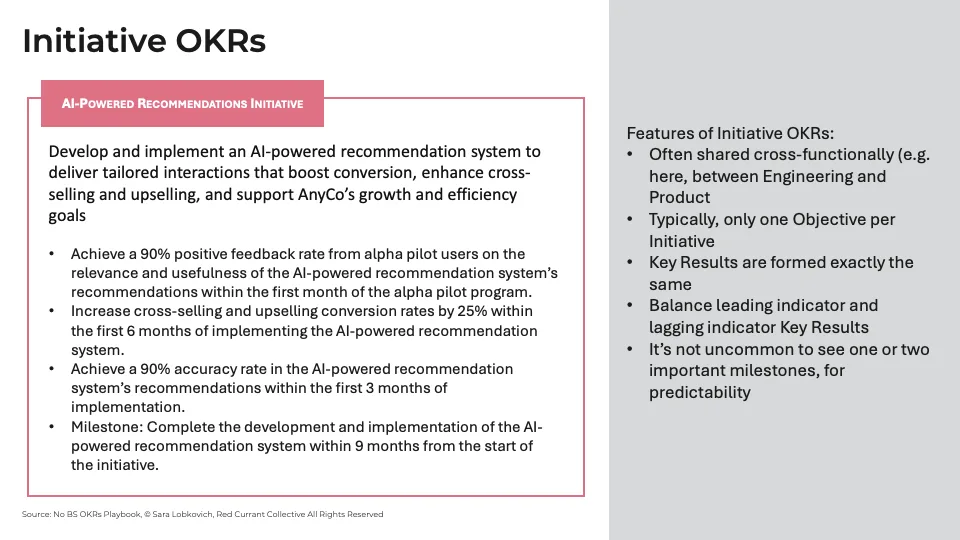
When a specific initiative is important enough to need its own success measures — and where completion alone isn’t success — it gets its own OKRs. Initiative OKRs are often cross-functional, shared between teams like engineering and product.
Here’s an initiative OKR for AnyCo’s AI-powered recommendations project:
Initiative: AI-Powered Recommendations Initiative
Develop and implement an AI-powered recommendation system to deliver tailored interactions that boost conversion, enhance cross-selling and upselling, and support AnyCo’s growth and efficiency goals.
Key Results:
- Achieve a 90% positive feedback rate from alpha pilot users on the relevance and usefulness of recommendations within the first month of the pilot
- Increase cross-selling and upselling conversion rates by 25% within the first 6 months of implementation
- Achieve a 90% accuracy rate in recommendations within the first 3 months of implementation
Milestone:
- Complete development and implementation of the AI-powered recommendation system within 9 months from the start of the initiative
Notice the milestone: it sits alongside the key results, not because it’s a key result itself, but because it’s a sufficiently important deadline to keep visible. It’s also not uncommon to see one or two milestones in initiative OKRs — especially when a major deadline needs to stay front of mind alongside the outcome goals.
Goals at the Individual Level
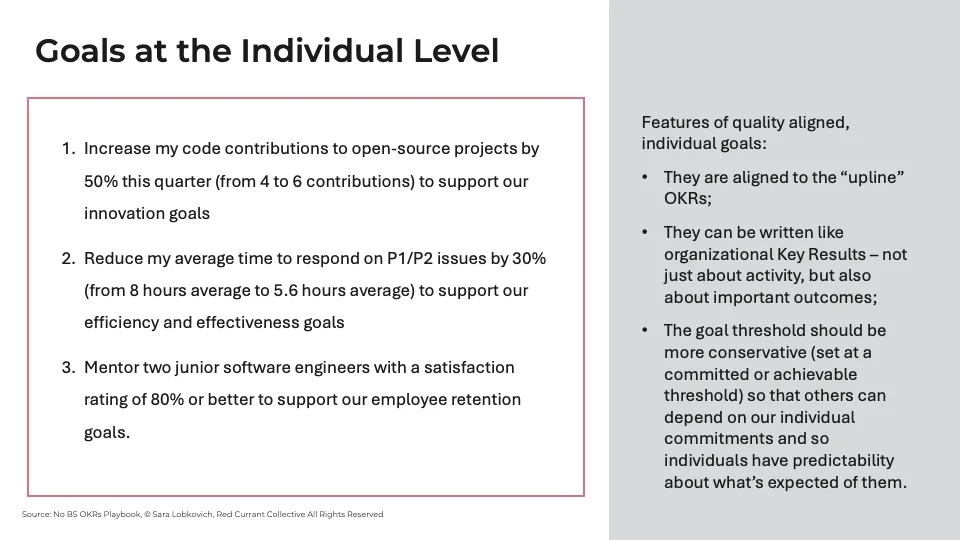
At the individual level, No-BS OKRs uses a bottom-up approach: rather than mandating OKRs for every employee, we invite each person to set goals that align to whatever level of the company OKRs is most relevant to their work. Individual goals are written like organizational key results — outcome-oriented, not just activity lists.
Here’s an example from an individual software engineer on AnyCo’s technology team:
- Increase code contributions to open-source projects by 50% this quarter (from 4 to 6 contributions) — to support our innovation goals
- Reduce average time to respond on P1/P2 issues by 30% (from 8 hours average to 5.6 hours average) — to support our efficiency and effectiveness goals
- Mentor two junior software engineers with a satisfaction rating of 80% or better — to support our employee retention goals
A few features worth noting: each goal explicitly connects to an upline objective, so this person always knows why their goal matters in context. The goal thresholds are more conservative than stretch goals — set at a committed, achievable level — because individual goals are commitments that others depend on.
More Team-Level Examples: Hard-to-Measure Functions
The AnyCo examples above show a technology function with clear, quantifiable metrics. These next examples show what OKRs look like in functions where the metrics aren’t as obvious — and where one of No-BS OKRs’ most distinctive features does a lot of the work.
OKR Examples for Product Teams
This hypothetical product team is juggling customer expectations, internal stakeholders, and technical constraints, making goal setting complex. Their objective may be:
Create a friction-free product experience that delights users and promotes sustainable growth.
Examples of key results here might be:
Outcome Key Result: Improve weekly active user retention from 45% to 70% within 90 days post-launch.
While the team might not control retention fully, aiming for this outcome guides prioritization.
Progress Key Result: Reduce the average user path to value from seven clicks to three by the end of the quarter.
This process-focused metric serves as a leading indicator of progress toward the major outcome of user retention.
Target Behavior Key Result: Increase spontaneous user feedback mentioning ease of use from zero to five comments per week.
Target Behavior Key Results are unique to No-BS OKRs: they let you set goals about important things that need to change, where you don’t yet have instrumented business metrics. Anything that can be observed or listened for can be counted, and a goal set around. Though not a formal metric today, this behavior indicates whether the product improvements is heading in the right direction.
This mix of outcome, process, and behavior key results gives product teams clear focus while recognizing some metrics need observation and adjustment to steer decisions.
OKR Examples for Creative Teams
This hypothetical creative team has to balance significant client demands with their own energy and sustainability. They’ve been burning hot for awhile, and cracks are starting to show in the team’s resilience.
An objective here might be:
Balance delivering remarkable client work with nurturing our team’s creative energy to avoid burnout.
That answers clearly the questions of:
What’s most important to focus on? + Why does that matter?
Example key results in this situation might include:
Outcome Key Result: Increase new client referrals by four per month (from two to six).
This is a taller order than most “client satisfaction” goals: it’s a higher bar (and more valuable) for clients to be satisfied ENOUGH to recommend your work.
“But Sara, that’s not within our control! We can’t set a goal we don’t control the outcome of — that’s demotivating if we don’t achieve it!”
Actually, dear reader — that’s a thought gremlin we work to eradicate with No-BS OKRs.
If you’ve set a goal you control the outcome of, you’ve created a plan, not a goal.
The strongest key results are almost always written about what we aspire to achieve if everything goes right , and even if there are variables that we don’t fully control. Planning is for the known. Goal setting is for the unknown. And key results are stretch goals about the unknown: which means we can hope to influence them, but not control the outcome completely.
And failing to achieve a stretch goal is only demotivating if the organizational behavior makes it that way. If leaders are walking the talk of No-BS OKRs, then they’re modeling that stretch goals are not “win/lose” propositions: they’re “win/learn” scenarios. It may be necessary to fail at a goal for a long time to learn what you need to know to ultimately succeed… and that’s only demotivating if the goal is actually truly impossible, or, if the organization imposes consequences for failure — which is against the rules of No-BS OKRs.
Progress Key Result: Boost client satisfaction scores on pulse surveys by 10 percentage points.
Tracking client satisfaction is an important indicator of progress toward the outcome key result above — if client satisfaction starts to slip, that important outcome (and your objective) may be at risk.
Progress Key Result: Improve the team’s average internal energy score from six to eight, using a biweekly self-assessment model.
This focus on sustainability helps reduce burnout risk.
OKRs aren’t only about the first measures to come to mind (which are almost always financial). OKRs provide a space for aligning on what needs to grow or improve in terms of culture, operational excellence, human experiences, and many other aspects of the business.
Why Target Behavior Key Results Matter
You’ve seen Target Behavior Key Results appear in the examples above — most notably in the product team section. This is one of the most distinctively No-BS features of this approach, and it’s worth a direct explanation.
A Target Behavior Key Result is a key result written around an observable behavior: something you can see, hear, or count in an area of the business where you don’t yet have formal instrumented metrics.
The logic: anything that can be observed or listened for can be counted. If something matters enough to care about, it’s worth counting — even before you’ve built the dashboard for it.
Most OKR approaches create a systematic bias toward metrics that are already instrumented: financial targets, completion rates, NPS scores. That leaves the stuff that actually drives long-term success — culture, product feel, customer relationships — unmeasured and unmanaged.
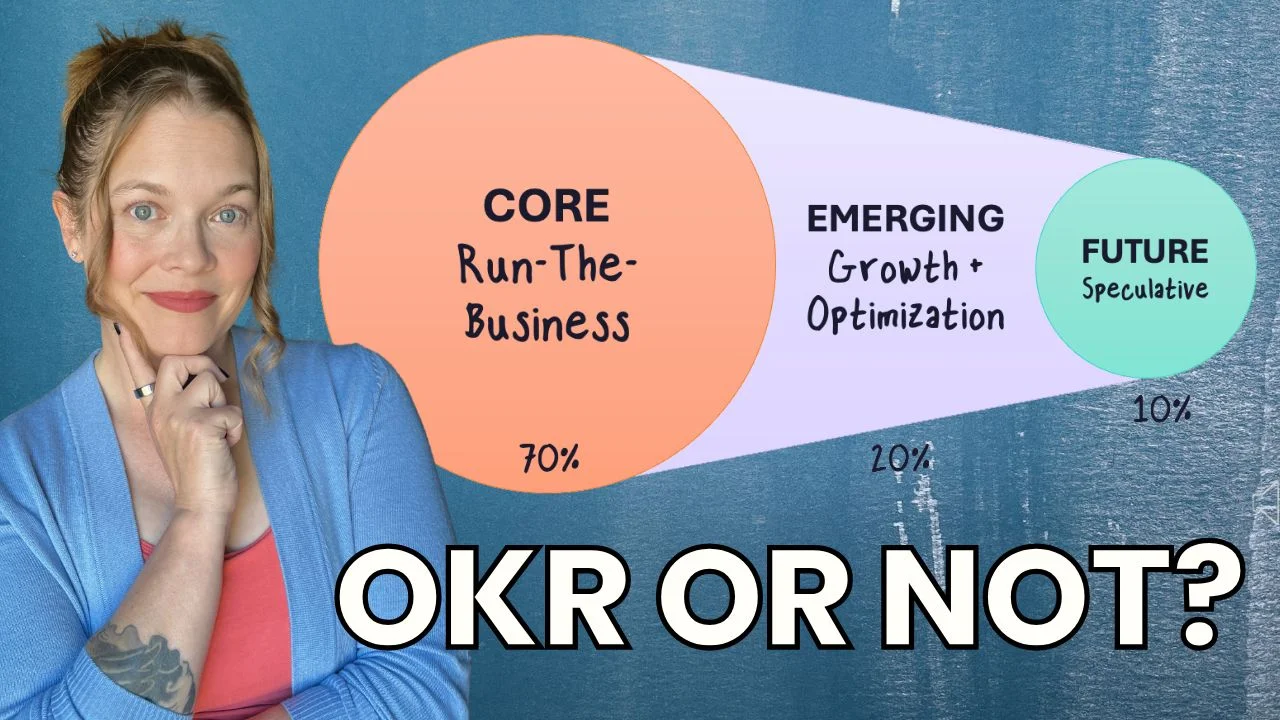
Target Behavior Key Results close that gap. They let you set meaningful, observable goals in the parts of the business where you’re working toward unknowns — the 20% and 10% zones where you can’t yet fully quantify what success looks like, but you can still define what you’ll listen and look for.
How OKRs Drive Clarity and Better Decisions
One of the main advantages of well-crafted OKRs is how they shape everyday decision-making.
For example, when a product team has “improving weekly active user retention” as a key result, prioritizing features or fixes that support retention naturally takes precedence over other features or fixes that aren’t aligned to what the organization has agreed its key results are. This alignment helps avoid distractions and keeps energy focused on efforts and outcomes that matter most.
Similarly, by including target behavior key results such as frequency of positive user comments or progress metrics like team energy scores, teams can monitor early signals or intangible factors that impact success but may not be captured by more traditional metrics or KPIs.
Frequently Asked Questions About These OKR Examples
Why does the AnyCo initiative OKR include a milestone? I thought milestones weren't key results.
They're not — and that distinction is intentional. A milestone is a completion-based target: either the AI recommendations system is delivered within 9 months or it isn't. A key result is an outcome- or progress-based target where partial progress matters and where the number tells you something about how things are going.
The AnyCo initiative OKR lists the 9-month implementation timeline clearly labeled as a milestone because that deadline is important enough to keep visible alongside the key results. Calling it a key result would misrepresent what it is. You can't be objectively "halfway toward a milestone" the way you can track toward a 90% accuracy rate — even though it's common to see organizational OKR sets where everything is labeled "measurable" because it has an estimated percent complete. Estimating completion isn't an objective measure, and "get X done by Y date" isn't either. So we label it differently: a Milestone. Milestones for major deliverables can be important enough to surface alongside key results — but that doesn't make them key results themselves.
What are Target Behavior Key Results, and why do they only appear in the product team example?
Target Behavior Key Results let you observe and count the number of times something important happens — before it has a formal instrumented metric. In the product team example, "ease of use" isn't captured by a dashboard, but you can count how often users spontaneously mention it in feedback. That observable behavior can be counted, and a key result can be created around it.
Target Behavior Key Results can be used by any team, in any part of the organization — and sometimes they're among the most transformative key results a team can implement. They're useful anytime the most important signal is observational rather than already instrumented.
If your key results are reflected in existing measurable data, use that. Target Behavior Key Results are for the gap: things that genuinely matter but where you haven't built — or can't build — the measurement infrastructure yet. They're one of the most distinctive features of No-BS OKRs, because most other frameworks create a conscious or implicit bias toward metrics you already have.
Why does the AnyCo technology team only have three themes when the company has four?
As you move down through the organization, I encourage teams to identify fewer themes for focus than are present at the company level — for a few reasons. Company-level OKRs are highly cross-functional and need to create space for everyone in the organization to align to; the remit of a specific team is narrower, so there's less necessity for that breadth. Teams also need to account for the fact that they're not only responsible for OKRs — they have mandatories, milestones, and run-the-business activities that sit outside the OKRs in project plans and delivery. Packing too many directions into the OKRs creates more work, when what we're trying to do is focus.
Localization doesn't mean copying every company objective down to your team. It means translating the ones your team can meaningfully influence.
In this example, a technology function doesn't own the company's capital allocation strategy. They localize operations, sustainability, and culture — the areas where their work connects. The technology team's set is also intentionally tighter because team members will have initiative OKRs and individual goals on top of their functional OKRs. Keeping room on the page is part of the design.
Why are individual goals described as being set at a "more conservative" threshold than company-level OKRs?
Two reasons. First, individual goals are often commitments others must depend on.
At the company level, key results are stretch goals — ambitious targets where we're safe to fail in the pursuit of learning. At the individual level, that's sometimes but not always the case: often, individual goals must be at least to some degree attained.
The software engineer in the AnyCo example sets goals at an achievable threshold — not because ambition doesn't matter, but because colleagues are counting on those commitments as dependencies. If someone is counting on you to respond to P1/P2 issues within a certain window, setting that goal as a stretch means building unpredictability into a place where others need reliability. Stretch goals belong at the collective level. Dependable commitments belong at the individual level.
Second, my personal philosophy is that goals individuals are evaluated on should leave as little room for subjectivity as possible — to avoid bias in the evaluation and performance management process. Read more about the intersection between No-BS OKRs and performance management.
The creative team example says to write key results around things you can't fully control. Doesn't that set teams up to fail?
Great question. It only sets teams up to "fail" if the organization treats missing a stretch goal as failure — which is against the rules of No-BS OKRs.
If a key result is something you can fully control the outcome of, you've described a plan, not a goal. The creative team's "increase client referrals" target is valuable precisely because clients choosing to refer you is a higher bar than satisfaction scores, and because the team aims to influence it — even though they can't guarantee they'll achieve it. Strong key results are written about aspirational outcomes. They answer the question: What might be possible if everything goes right? — which almost always includes variables you don't fully control.
No-BS OKRs treats speculative stretch goals in areas of the business where we have unknowns as win/learn scenarios. If you're falling short, that's information. It only becomes demotivating when leadership imposes consequences for missing a goal that was intended to be a stretch — with safety to fail. That's an organizational behavior and coherence problem, not an OKR design problem.
Summary and Next Steps to Effective OKRs
Teams that do OKRs well don’t try to measure everything; they prioritize goals that genuinely move the needle in terms of progress, and toward important outcomes. They combine ambitious goals with pragmatic process improvements and behavioral indicators to track progress, learning, and achievement from multiple angles. This balanced approach makes OKRs an effective tool for navigating complexity and driving sustained growth (even in chaotic and fast-changing or hard-to-predict operating situations).
If you are working on a goal or a challenge at your organization, consider how an objective paired with clear key results could bring clarity, focus, and alignment to your efforts.
Key Takeaway: Using OKRs to Increase Clarity and Focus
OKRs provide a powerful framework to sharpen organizational focus through a clear objective that explains what’s most important and why it matters — your focus and purpose — and measurable key results that define what progress and success might mean, if everything goes right.
Creating and implementing OKRs thoughtfully in different parts of your business—whether product development, creative teams, strategy, or other sometimes hard-to-measure areas—helps your teams prioritize what truly matters while tracking progress via outcomes, progress indicators, and observable behaviors (including spontaneous feedback). This strategic clarity ensures everyone understands the organization’s shared goals and can align their work accordingly.
Ready to bring more clarity and impact to your organizational goals?
Start by defining one clear objective and supporting key results for your next goal cycle. This focus can transform how your team works and delivers value.
Taking the first step to implement OKRs can be a game-changer for your team’s productivity and engagement.
Want More No-BS OKR Fundamentals?
-
Download a free example: Get the Connected Strategic Stack Example — a one-page framework that shows how OKRs connect to vision, strategy, and daily work
-
Read the book: Visit the book page for You Are a Strategist: Use No-BS OKRs to Get Big Things Done
-
Subscribe to my No-BS OKRs Fundamentals YouTube Playlist here
-
Check out my new No-BS OKRs Fundamentals Private Podcast, or